
Somewhere around your child’s third birthday, a quiet question starts sitting in the back of your mind. You watch them at a birthday party — the way they hover at the edge of the group, or dive straight in, or melt down when it is time to leave — and you think: is my child ready for school?
It is not panic. It is not certainty. It is that particular parental uncertainty that arrives precisely when admission season does, usually accompanied by well-meaning relatives, contradictory advice, and at least one WhatsApp forward about school readiness checklists.
Here is what you should know before you read any further: this uncertainty is universal. Almost every parent of a three or four-year-old feels it. And it does not reflect on your child’s intelligence, your parenting, or your child’s future. It simply reflects the fact that kindergarten readiness is not a switch that flips on a particular birthday. It is a range of skills — social, emotional, physical, and communicative — that emerge gradually and at different paces for different children.
This guide covers two things. First, what kindergarten readiness actually looks like across the four domains that early childhood educators look for. Second — and this is the part most articles skip — what to do if your child is not quite there yet because that second question is usually the real one.
What Kindergarten Readiness Actually Means
Before we get to the signs, it is worth clearing up the most common misconception about kindergarten readiness: it is not about academic knowledge.
When parents ask whether their child is ready for school, they often mean: can they recognise letters? Can they count? Do they know their colours and shapes? These are reasonable things to wonder about. But they are not what kindergarten readiness actually measures — and more importantly, they are not what a good kindergarten programme requires on day one.
A well-designed kindergarten teaches the alphabet, numbers, colours, shapes, and early literacy. That is its job. What it cannot easily teach — and what makes a genuine difference to how smoothly a child settles in — is the foundational social, emotional, physical, and communication capacity to benefit from that environment.
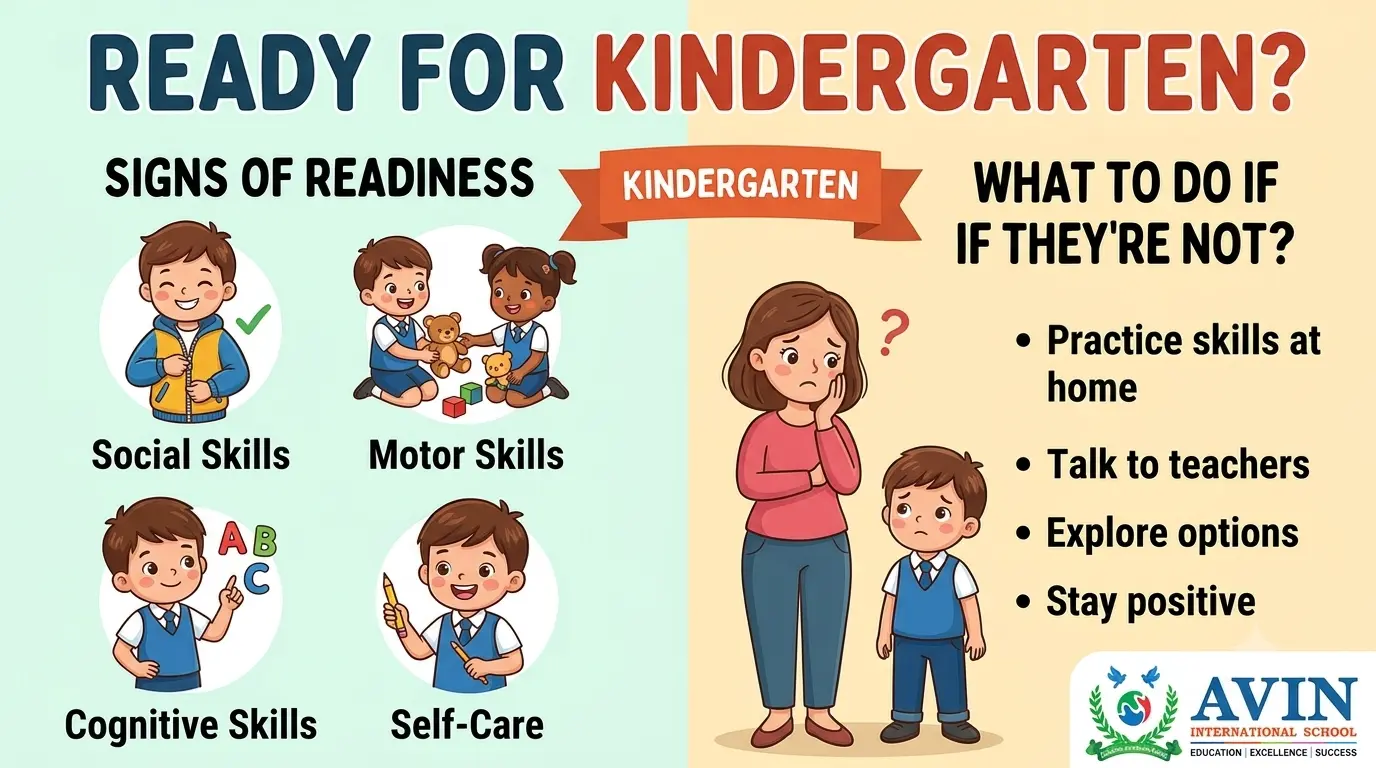
Early childhood educators assess readiness across four domains:
- Social and emotional development: how the child manages relationships, emotions, and brief separations
- Physical and motor development: how the child handles their body, objects, and physical space
- Communication and language: how the child expresses needs, follows instructions, and engages with others verbally
- Self-care and independence: how the child manages basic daily tasks without constant adult support
A child does not need to be strong across all four areas to be ready. Most children arrive at kindergarten with relative strengths in some domains and gaps in others. That is entirely normal. The question is not ‘is my child perfect’ — it is ‘does my child have enough of a foundation to settle in and benefit from being there’.
The Four Domains of Kindergarten Readiness
Here is what each domain looks like in practice, and the specific signs you can observe at home.
| Domain 1: Social and Emotional Readiness |
Kindergarten is, above all else, a social environment. Your child will spend their day alongside twenty or more other children, navigating shared space, shared materials, and a relationship with an adult they have never met before. Social and emotional readiness is about whether they have the basic tools to do that without becoming overwhelmed.
Signs to look for:
- Can separate from you without prolonged or extreme distress. Brief upset at drop-off is completely normal and expected — even for ready children. What matters is whether the child settles within a reasonable time once you have gone, not whether they cry at goodbye.
- Shows interest in other children. This does not mean they have to be outgoing. A child who watches other children play with curiosity, or who moves closer to observe, is showing social awareness. Readiness does not require confidence — it requires interest.
- Can take turns, even imperfectly. A child who understands the concept of waiting their turn in a simple game — even if they need reminding — has the beginnings of the social awareness kindergarten requires.
- Expresses basic emotions using words or gestures. Happy, sad, scared, angry — a child who can communicate their emotional state, even simply, is far better equipped to handle the inevitable frustrations of a new environment.
- Can stay engaged in an activity independently for five to ten minutes. Not every minute, not under pressure, but at least some of the time. A child who can absorb themselves in play without requiring constant adult interaction is showing a readiness for the relative independence of a classroom.
| A note on shy children: shyness is not a readiness gap. An introverted child who observes carefully before joining in is showing social awareness. Conflating social confidence with social readiness is one of the most common anxieties parents bring to admission conversations — and one of the least warranted. |
| Domain 2: Physical and Motor Readiness |
Kindergarten involves sitting at a table, moving through a classroom, handling materials, drawing, cutting, building, and navigating outdoor spaces. Physical readiness is about whether your child can manage their body comfortably enough to participate in these activities.
Fine motor skills
- Holds a crayon or pencil with a basic grip. It does not need to be a perfect tripod grip — that develops over time. What matters is that they can hold and use a writing tool with some control.
- Can manipulate small objects. Threading beads, completing simple puzzles, stacking blocks, turning the pages of a book one at a time — these fine motor tasks build the hand strength and coordination that writing and drawing require.
- Attempts to draw shapes, lines, or figures. Even abstract scribbles count. The point is whether the child is using a tool intentionally to make marks on a page.
Gross motor skills
- Walks, runs, climbs, and balances with reasonable coordination. A child who can navigate a playground, manage low climbing structures, and recover from minor stumbles without panic is physically ready for the school environment.
- Can manage stairs without assistance. Most school buildings involve stairs, corridors, and varied terrain. Basic navigation confidence matters.
- Has energy for two to three hours of mixed activity. A kindergarten morning involves transitions between sitting, moving, playing, and eating. Sufficient stamina for this rhythm is part of physical readiness.
| Domain 3: Communication and Language Readiness |
Language is how your child asks for help, makes friends, tells a teacher they are not feeling well, and engages with the stories and instructions that form the fabric of kindergarten life. Communication readiness is one of the strongest early predictors of how smoothly a child settles into school.
- Speaks in short sentences of three to five words. Language development varies considerably between age three and five. The key question is not vocabulary size but whether the child can string words together to communicate meaning.
- Follows simple two-step instructions. ‘Pick up your pencil and put it in the box.’ ‘Go to your bag and bring me your water bottle.’ A child who can hold a two-part instruction in mind and act on both parts has an important foundational skill.
- Can make basic needs understood. Hunger, thirst, discomfort, the need for the toilet — a child who can communicate these needs, either verbally or through clear signals, can get what they need in a classroom without distress.
- Asks questions. A child who uses ‘what’, ‘where’, or ‘who’ to explore the world is developing the communicative curiosity that supports early learning.
- Sustains a simple back-and-forth conversation for a few turns. Not a sophisticated dialogue — just the basic social exchange of speaking and listening in turn.
| For families who speak Kannada, Tamil, Telugu, or another language at home: a child’s English vocabulary may be smaller than that of a child from an English-speaking household. This is not a readiness gap — it is a language exposure difference that a good kindergarten programme addresses actively and sensitively. Do not delay enrolment because your child’s English is limited. |
| Domain 4: Self-Care and Independence Readiness |
A kindergarten teacher managing a class of twenty children cannot attend to every individual need at every moment. Basic self-care independence allows your child to feel capable and reduces the separation anxiety that comes from feeling helpless in a new environment.
- Indicates when they need to use the toilet. Full independence is not required at age three. What matters is that the child is aware of the need and can communicate it to an adult rather than simply having an accident without saying anything.
- Eats independently. Can use a spoon, open a lunchbox, drink from a water bottle without spillage most of the time. A child who needs an adult to physically feed them will find a busy classroom environment challenging.
- Can put on and remove shoes. Lace-tying is not expected at age three or four. Velcro shoes are perfectly fine. The point is that the child can manage the basic mechanics of getting dressed and undressed with minimal help.
- Manages their bag with prompting. Opens, takes out their belongings, puts things back. This may need prompting in the early weeks, but the physical capability should be there.
- Can follow a simple routine of two to three steps when guided. Hang up your bag, sit at your place, take out your drawing materials. A child who can follow a predictable sequence, even with reminders, transitions into school routines with much less friction.
Kindergarten Readiness Checklist: Ages 3–5
Use the checklist below as a guide, not a gate. Your child does not need to tick every box to be ready. Most children will have a mix of ticks and blanks, and that is entirely normal. What the checklist gives you is a picture of where your child is across the four domains — and which areas might benefit from a little more attention before or after enrolment.
| Domain 1: Social & Emotional |
| ☐ Separates from parent without prolonged extreme distress |
| ☐ Shows interest in other children — watches, moves closer, attempts interaction |
| ☐ Takes turns in simple activities, even with reminders |
| ☐ Uses words or gestures to express basic emotions |
| ☐ Stays engaged in a self-chosen activity independently for 5–10 minutes |
| ☐ Does not require constant one-on-one adult attention to remain settled |
| Domain 2: Physical & Motor |
| ☐ Holds a crayon or pencil with a basic grip |
| ☐ Manipulates small objects: puzzles, blocks, threading beads |
| ☐ Attempts to draw shapes, lines, or recognisable figures |
| ☐ Runs, climbs, and balances with reasonable coordination |
| ☐ Can manage stairs without support |
| ☐ Has stamina for 2–3 hours of varied activity |
| Domain 3: Communication & Language |
| ☐ Speaks in short sentences of 3–5 words |
| ☐ Follows two-step verbal instructions |
| ☐ Can communicate basic needs: hunger, thirst, toilet, discomfort |
| ☐ Asks questions using what, where, or who |
| ☐ Sustains a basic back-and-forth conversation for a few exchanges |
| ☐ Responds consistently to their own name |
| Domain 4: Self-Care & Independence |
| ☐ Indicates when they need to use the toilet |
| ☐ Eats independently and opens their own lunchbox |
| ☐ Can put on and remove shoes (lace-tying not required) |
| ☐ Manages their bag: opens, retrieves items, packs with prompting |
| ☐ Follows a simple 2–3 step daily routine when guided |
What to Do If Your Child Is Not Quite Ready?
If you worked through that checklist and found more blanks than ticks, take a breath. This is not a verdict. It means your child needs a little more time and the right kind of support — both of which are entirely within reach.
Here is how to think about it, and what you can do.
Consider whether waiting a year is the right call
For some children, particularly those born in the October to December window who often end up as the youngest in their cohort, a year of additional preparation can make a meaningful difference. Research on what is known as the ‘relative age effect’ consistently shows that being the youngest child in a year group can affect academic confidence and social ease in the early school years — not because younger children are less capable, but because a six-month developmental gap is significant at age three or four in a way it simply is not at age ten.
Waiting a year is not falling behind. A child who starts kindergarten at four rather than three does not end up academically disadvantaged. They often arrive more settled, more physically capable, and better equipped to benefit from the experience. The decision should be based on the child’s readiness profile — not on comparison with neighbours’ children or on social pressure from relatives.
Build readiness at home, domain by domain
If the checklist reveals specific gaps, targeted activities at home can make a real difference in the months before enrolment. Here is what works, organised by domain.
| To build social and emotional readiness:Arrange regular playdates with one or two children at a time — small groups are far less overwhelming than large gatherings. Play turn-taking games at home: simple board games, passing a ball, card games. Read picture books together and ask questions about how the characters feel — this builds emotional vocabulary more effectively than direct instruction. Practice brief separations: leave your child with a trusted grandparent or family member for an hour, then gradually extend. The goal is not to eliminate separation anxiety — it is to help your child discover that you always come back. |
| To build physical and motor readiness: Drawing, colouring, cutting with child-safe scissors, threading beads, playing with playdough, and building with small blocks all develop fine motor strength. None of these requires expensive materials or structured sessions — ten minutes of playdough at the kitchen table is genuinely effective. For gross motor development, outdoor play is irreplaceable: climbing frames, ball games, simple obstacle courses, and free running build the coordination and confidence that a school environment requires. Encourage your child to dress and undress themselves, button their own shirt, and manage their own shoes. |
| To build communication and language readiness: Talk with your child constantly and in full sentences. Narrate what you are doing, ask open questions, and wait for their answers rather than finishing sentences for them. Read aloud every single day — even five to ten minutes of picture book reading builds vocabulary, listening, and comprehension more powerfully than any worksheet. Sing nursery rhymes and songs together: rhythm, repetition, and rhyme are foundational to language development. If you have genuine concerns about your child’s speech — not just slower development, but concerns about clarity or understanding — consult a speech therapist early. Early intervention is highly effective and makes an enormous difference when started before school. |
| To build self-care and independence readiness: Establish predictable daily routines: wake, eat, play, rest, bath, bed. Children who live in routines adapt to school routines significantly faster than children whose days are unstructured. Give your child small, consistent responsibilities: putting their plate in the sink, tidying their toys, packing their bag the night before. Practice school scenarios at home: sitting at a table to draw for ten minutes, waiting to ask a question, asking for something politely. These small rehearsals reduce the novelty factor of the classroom and make the transition feel less enormous. |
Choose a kindergarten programme designed for developing children
Not all kindergarten programmes are built equally, and this matters particularly for children who are still developing their readiness foundations.
When evaluating a school for a child on the edge of readiness, look specifically for:
- A low teacher-to-student ratio. The lower the ratio, the more individual attention each child receives during the settling-in phase. This makes an outsized difference for children who need more support in the early weeks.
- A play-based or Montessori-inspired approach. Programmes that allow children to develop at their own pace through structured play are far better suited to children across a wide range of readiness levels than programmes with a rigid, curriculum-first approach from day one.
- Regular communication with parents. A school that keeps you informed about how your child is settling — not just at term-end report cards, but during those first crucial weeks — is a school that is paying attention.
- Emotionally aware early years teachers. Teachers who understand that the first few weeks of kindergarten are an adjustment, not a performance, create the safety that allows children to settle at their own pace.
| At AVIN International School, Kengeri, our Kindergarten programme spans K1 to K3 and begins at age three. It is built on a Montessori-inspired, play-based approach that meets children where they are rather than where a syllabus says they should be. Our early years teachers are specifically trained for this age group and understand that the settling-in phase looks different for every child. If you have questions about whether your child is ready, our admissions team is the right first conversation — not a checklist. |
A Quick Note on Age and Admission Cut-offs in Bangalore
Parents often ask about the official age requirements for kindergarten admission in Bangalore, so here is a brief, practical answer.
In Karnataka, the general guideline for entry to Class 1 is that the child should be six years of age as of June 1st of the admission year. Working back from this, Nursery or K1 entry typically falls at age three to four, depending on the school’s own programme structure.
At AVIN International School, children aged three and above as of June 2026 are eligible for Nursery and K1 admission for the 2026–27 academic year. Our three-level KG programme — K1, K2, and K3 — is designed as a progressive journey that builds foundational skills incrementally across three years.
Age cut-off dates vary between schools: some use June 1st, others use March 31st. Always confirm directly with the school. And if your child misses the cut-off by a month or two, the right response is almost always to wait rather than push for an early start — those extra months matter considerably more at age three than they will at any later point in your child’s education.
One Last Thing for Anxious Parents
Readiness is a range, not a threshold. Most children arrive at the edge of kindergarten somewhere in the middle of that range — strong in some areas, still developing in others, uncertain about a few things, surprisingly capable at others. That is what being three or four years old looks like.
The goal is not to find a child who is fully formed before they arrive. The goal is to find a school that meets them where they are and supports them the rest of the way. A nurturing kindergarten programme, with patient teachers and a play-based approach, will do far more for a child’s development than waiting until every box is ticked.
Trust your knowledge of your child. Use the checklist as a tool, not a judgement. And choose a school that treats the first day as the beginning of a journey — not an audition.
Curious about what a first day at AVIN’s Kindergarten looks like? Come and see it for yourself. Book a campus visit and let our early years team answer your questions in person. Admissions are open for 2026–27.
Frequently Asked Questions
What is the right age to start kindergarten in India?
Most kindergarten programmes in India accept children from age three for Nursery or K1. Entry to Class 1 typically requires the child to be six years old as of June 1st of the academic year. Age is a factor in readiness, but it is not the only one — a child’s social, emotional, and physical development matters as much as their chronological age.
How do I know if my 3-year-old is ready for school?
Look for these four foundational signs: the ability to separate from you without extreme prolonged distress, an interest in other children, the ability to make basic needs understood verbally or through clear signals, and some basic self-care independence such as eating and drinking without help. Academic knowledge is not required at age three — a good kindergarten programme will teach those skills.
What if my child cries at school drop-off every day?
Brief upset at drop-off is entirely normal for the first two to four weeks of kindergarten, even for children who are developmentally ready. Keep your goodbyes short, warm, and consistent — long, drawn-out farewells tend to extend the distress rather than ease it. If persistent crying continues beyond four to six weeks, speak with the class teacher to understand what is happening once you leave.
Should I delay kindergarten if my child seems immature?
Delaying by a year is a valid and often beneficial choice, particularly for children born in the later months of the year who may be significantly younger than their classmates. Consult your child’s paediatrician and the school’s admissions team for guidance specific to your child. A year of targeted development at home, followed by a more confident start, often produces better long-term outcomes than an early start in a stressful environment.
What should a child know before starting kindergarten?
Nothing academic is required before kindergarten. A child who can manage basic self-care, communicate simple needs, show interest in other children, and tolerate brief separation from parents has the foundations needed to benefit from kindergarten. The school teaches colours, letters, numbers, and early literacy — that is precisely its purpose.
Does AVIN International School accept children who are still developing readiness?
Yes. AVIN’s K1 to K3 programme is built on a play-based, Montessori-inspired approach designed to meet children across a wide range of developmental stages. Our early years teachers are experienced in supporting children through the settling-in phase at their own pace. If you have questions about whether your child is ready, we encourage you to speak with our admissions team directly — a conversation is always more useful than a checklist.