
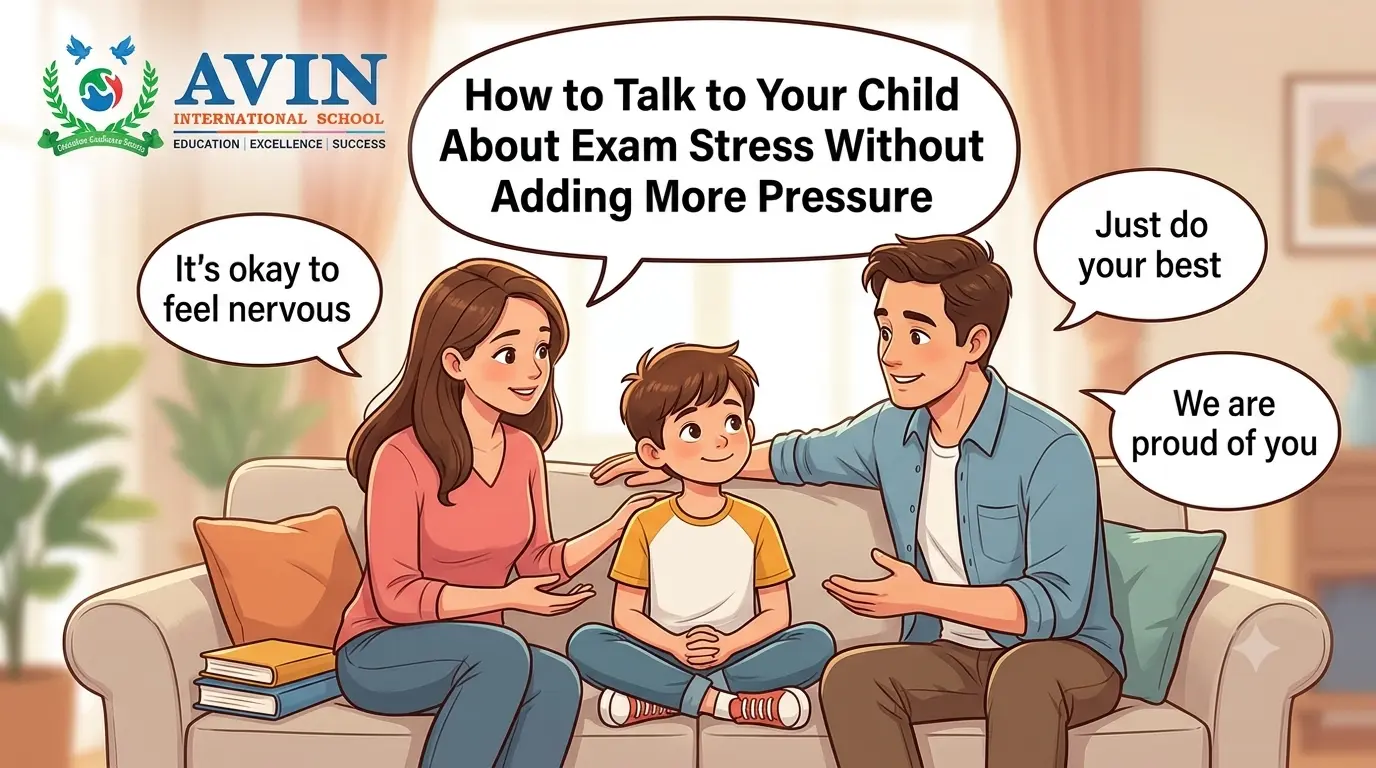
You have been watching your child for the past few days. Something is off. They are quieter than usual, slower to laugh, quicker to snap. They sit at their desk but you are not sure anything is actually going in. You want to help. You want to say the right thing. But every time you bring up exams, the atmosphere in the room changes — and not for the better.
This is one of the most common and least talked-about parenting dilemmas in India. Parents who care deeply about their child’s well-being find themselves, accidentally, becoming a source of the very pressure they are trying to relieve. Not because they say the wrong things deliberately. But because the emotional stakes feel so high that even a simple question — ‘Have you studied?’ — arrives loaded with everything it is attached to.
This blog is not going to tell you what you are doing wrong. It is going to give you something more useful: actual language. Real words, real sentences, organised by the specific situations that come up most during exam season — so that the next time you walk into your child’s room, you have something better than good intentions.
Wanting to talk to your child about exams is already the right instinct. The goal here is just to help you do it in a way that opens the door rather than quietly closes it.
Why Exam Stress Is Different From Ordinary Academic Pressure
Exams are not simply harder homework. They compress months of learning into a few high-visibility hours and attach a public, measurable result to the outcome. For most children, that combination is genuinely stressful — and understanding why helps parents respond more effectively.
The first thing worth knowing is that children absorb parental anxiety even when parents work hard to hide it. A parent who is silently worried about their child’s performance communicates that worry through the frequency of their questions, the tension in their voice, the way they hover near the study room. Children are extraordinarily sensitive to these signals. A parent who says ‘no pressure’ while visibly anxious sends a mixed message, and children almost always read the non-verbal one.
For children in Grades 9 and 10 preparing for CBSE board exams, the pressure has an additional social dimension that younger children do not yet carry. Results become public in a way that earlier assessments are not. Cousins are mentioned. Neighbours ask. Extended family weighs in. The child’s academic performance starts to feel like a statement about the whole family, which is an enormous weight for a fifteen-year-old to manage alongside the actual revision.
It is also worth separating exam stress from exam unpreparedness. A child who is well-prepared can still experience severe anxiety. A child who is behind on revision may be remarkably calm. The two problems are different and require different responses. Assuming that a stressed child simply needs to study more is one of the most common and counterproductive mistakes parents make during exam season.
The parent’s most important role during this period is not coach, examiner, or revision planner. It is safe harbour. A child who knows that home is a place where their worth is not tied to their marks will consistently manage exam stress better than one who does not. That certainty is worth more than any revision schedule.
How to Recognise Exam Stress in Your Child
Parents cannot respond to stress they have not recognised. And exam stress is surprisingly easy to misread — particularly when it shows up as the behaviours that look most like not caring.
Behavioural signs
- Avoidance. Suddenly very interested in rearranging their room, rewatching shows they have already seen, doing anything except opening their textbooks. Avoidance is almost never about laziness. It is almost always about overwhelm.
- Irritability and short temper. Snapping at siblings, reacting disproportionately to small frustrations, withdrawing from family interaction. This is dysregulation, not attitude — a nervous system that is already stretched thin has very little buffer left for ordinary friction.
- Procrastination followed by panic. The child who spends four hours ‘about to start’ and then studies frantically for two hours before bed is not being strategic. They are cycling between anxiety and action in the only way they know how to manage it.
- Emotional outbursts that seem to come from nowhere. Crying over something small, or anger that arrives without obvious cause. These are pressure valves releasing stress that has nowhere else to go.
Physical signs
- Disrupted sleep. Difficulty falling asleep, waking in the night with anxious thoughts, or oversleeping as the body shuts down under prolonged stress.
- Changes in appetite. Loss of interest in food, or comfort eating as a coping mechanism. Neither is the child being difficult.
- Physical complaints without medical cause. Headaches and stomach aches that appear specifically around exam periods are well-documented stress responses in school-age children. They are not imagined or exaggerated.
Cognitive signs
- Catastrophising language. ‘I’m going to fail.’ ‘I’m stupid.’ ‘I don’t know anything.’ These are not accurate assessments — they are expressions of a mind that has been overwhelmed to the point where it cannot evaluate itself realistically.
- Forgetting material they clearly know. Anxiety impairs memory retrieval. A child who blanks on a concept under pressure is not bluffing about having studied it.
- Paralysis in front of the full syllabus. Looking at everything that needs to be revised and being unable to start any of it. This is not laziness — it is cognitive overload.
| The child who is avoiding revision is far more likely to be overwhelmed than indifferent. Recognising this changes everything about how you enter the conversation. |
Three Principles Before the Scripts
Before specific language, three principles that sit underneath every productive exam conversation. Without these, even the best scripts will not land the way you intend.
1. Listen before advising.
When a child expresses stress, the immediate parental instinct is to fix it — to offer perspective, solutions, or reassurance. Resist this. Ask one open question and then actually listen to the answer before saying anything else. Most children who are stressed do not need solutions as urgently as they need to feel that their experience has been heard. Being listened to without interruption is itself regulating. It brings the nervous system down in a way that being advised does not.
2. Separate performance from worth, explicitly and repeatedly.
Children need to hear clearly — not once, but regularly — that their exam results are not a measure of their value, their intelligence, or their future. This is not simply reassuring language. It is neurologically important. A child whose sense of identity is attached to their academic performance will experience qualitatively higher anxiety than one who has internalised a more stable sense of self. The message needs to come from you before they need it, not only after a bad result.
3. Watch your own signals.
The conversation starts before you open your mouth. A parent who says ‘no pressure’ while constantly checking revision schedules, making pointed remarks about study hours, or comparing their child to others is communicating pressure regardless of the words. Children are not fooled by the verbal message when the non-verbal one contradicts it. Managing your own anxiety about your child’s exams is not a luxury — it is part of the support you are trying to provide.
What to Actually Say: Scripts for Four Real Situations
Here is what most parents actually need: not principles, but words. What follows are conversation scripts for the four situations that come up most often during exam season, each with a ‘before and after’ comparison so you can see both what to avoid and what works better — and why.
| Situation 1: Your child is anxious the night before or morning of an exam |
This is when parental anxiety and child anxiety are most likely to collide. You want to reassure. They want to not be reminded. The room is already tense before anyone says anything.
| ❌ Instead of saying… | ✔ Try saying… |
| “You’ve studied enough, you’ll be fine. Stop worrying.” | “It sounds like you’re feeling nervous. That makes sense. What would help you feel a bit more settled right now?” |
| ❌ Instead of saying… | ✔ Try saying… |
| “Just do your best — that’s all I ask.” | “Whatever happens tomorrow, I’m proud of how hard you’ve worked. That part is already done.” |
| Why it works: Dismissing anxiety — ‘you’ll be fine’ — tells the child their feeling is wrong rather than helping them manage it. Naming the feeling first (‘it sounds like you’re nervous’) validates it and opens the door. The second reframe removes the implicit pressure in ‘do your best’ by anchoring pride in effort already completed, not in tomorrow’s outcome. |
| Situation 2: Your child comes home after an exam that did not go well |
The exam is over and your child already knows it. This is the moment parents most often make things worse without meaning to — by asking detailed questions, trying to analyse what happened, or offering reassurance that minimises rather than acknowledges.
| ❌ Instead of saying… | ✔ Try saying… |
| “How did it go? What questions came? Did you attempt all of them?” | “Tough one? Come and eat something. You don’t have to talk about it now if you don’t want to.” |
| ❌ Instead of saying… | ✔ Try saying… |
| “It’s okay, it’s just one exam. Don’t worry, there are more coming.” | “That sounds hard. I’m here if you want to talk, and I’m here if you just want company.” |
| Why it works: Immediately asking about the exam extends the stress of it rather than allowing the child to decompress. Offering food and space first is not avoidance — it is emotional regulation. ‘It’s just one exam’ is technically reassuring but emotionally dismissive because it minimises something the child experienced as significant. ‘That sounds hard’ acknowledges without catastrophising. |
| Situation 3: Your child says ‘I’m going to fail’ or ‘I’m so stupid’ |
Catastrophising language is one of the most distressing things a parent can hear — and one of the most common responses actually makes it worse. The instinct is either to argue with the assessment (‘Don’t say that, you’re not stupid’) or to over-reassure (‘You’re definitely going to pass’). Neither works because the child is not making a logical claim. They are expressing an emotional state.
| ❌ Instead of saying… | ✔ Try saying… |
| “Don’t say that, you’re not stupid! You know this material.” | “It sounds like you’re feeling really overwhelmed right now. Can you tell me what’s worrying you most?” |
| ❌ Instead of saying… | ✔ Try saying… |
| “Everyone feels like this before exams, you’ll definitely be fine.” | “I hear you. It feels impossible right now. Let’s just look at one topic together — not everything, just one.” |
| Why it works: Arguing with catastrophising rarely succeeds because the child is not open to logic in that moment — their nervous system is flooded. Validating the feeling first (‘I hear you, it feels impossible’) names the state without confirming the catastrophe. Narrowing the task to one subject, one chapter, one page interrupts the overwhelm spiral more effectively than any amount of reassurance. |
| Situation 4: Your child has shut down and refuses to engage |
Withdrawn, monosyllabic, door closed. This is often the hardest situation for parents because the instinct is to push for connection precisely when the child is actively retreating from it. For teenagers in particular, being pressured to talk when they have shut down often makes the withdrawal more complete.
| ❌ Instead of saying… | ✔ Try saying… |
| “You have to talk to me. I’m your parent and I’m worried about you.” | “I’m not going to push you to talk. I just want you to know I’m here when you’re ready.” |
| ❌ Instead of saying… | ✔ Try saying… |
| “If you don’t tell me what’s wrong I can’t help you.” | “Do you want to just sit together for a bit? We don’t have to say anything.” |
| Why it works: Demanding conversation when a child has shut down increases the pressure rather than relieving it. Offering presence without expectation — ‘I’m here when you’re ready’, ‘we don’t have to say anything’ — is what most eventually opens the door. Children, particularly teenagers, need to know that connection is available without conditions before they will accept it. The parent who waits without withdrawing is the one the child comes to. |
The Phrases That Backfire (Said With Love, Landed With Weight)
These are things almost every parent says at some point during exam season. They are said from love, from worry, from wanting the child to understand what is at stake. That is exactly why they are worth naming — because understanding why they land badly is the first step to replacing them.
- ‘We have sacrificed so much for your education.’ Intended as motivation. Received as guilt. Guilt is not a productive emotional state for learning. A child who is studying to relieve parental sacrifice is carrying a weight that has nothing to do with the exam in front of them.
- ‘Your cousin got 95%. Why can’t you?’ Comparison with others does not create motivation — it creates shame. Shame and effective learning are neurologically incompatible. A child who is thinking about their cousin’s marks cannot be fully present in their own revision.
- ‘This exam will decide your whole future.’ Factually questionable and emotionally catastrophic in equal measure. Even if a parent believes this, a child cannot study productively under existential stakes. The higher the declared importance of the outcome, the less able most children are to function effectively.
- ‘You’re not trying hard enough.’ Almost always incorrect. A child who appears not to be trying is almost always stuck, overwhelmed, or paralysed rather than indifferent. This phrase adds shame to an already unable state. It does not produce effort — it produces despair.
- ‘I’m not angry, just disappointed.’ Disappointment lands harder than anger for most children because it carries the message that they have failed to meet a standard of worthiness rather than simply broken a rule. This phrase is almost always used with the best intentions and reliably produces the worst outcomes.
- Asking ‘Have you studied?’ multiple times a day. Each repetition signals distrust and adds to the ambient pressure. Ask once. Then let it go. A child who is asked five times whether they have studied will spend mental energy managing that question rather than on the studying itself.
Building a Low-Pressure Exam Season at Home
Individual conversations matter. But the overall atmosphere of the home during exam season matters just as much. Here are the practical adjustments that make the biggest difference.
- Protect sleep above everything else. Late-night revision that cuts into sleep consistently produces worse exam performance than slightly less revision with adequate rest. This is one of the most well-established findings in learning science and one of the most frequently ignored pieces of advice. A tired brain cannot retrieve, process, or hold new information effectively regardless of how many hours it has spent trying.
- Keep meals and routines predictable. Stability in the small things reduces background anxiety and frees cognitive resources for studying. Regular mealtimes, a consistent bedtime ritual, and predictable family rhythms create a container of calm around the pressure of revision.
- Make the dinner table an exam-free zone. One hour of genuine relaxation — real conversation about something other than results, revision, or the future — is worth considerably more than an hour of performance anxiety passing as family interaction. Protect it deliberately.
- Acknowledge effort specifically and visibly. ‘I noticed you were at your desk for two hours this afternoon’ lands differently from ‘well done’. Specific acknowledgment of effort tells the child exactly what they did that was noticed and valued. It reinforces the thing that is actually within their control.
- Have a plan for after results, not just before them. The anticipation of what will happen when results come often drives more anxiety than the exam itself. Letting your child know explicitly that you have a plan — and that it involves support regardless of the outcome — removes one of the heaviest background weights of exam season.
| At AVIN International School, Kengeri, our exam support programme works alongside the academic calendar rather than separately from it. Students receive time management workshops, guided revision planning, breathing and mindfulness exercises, and access to counsellor check-ins during exam periods. The goal is not just exam coverage — it is exam confidence. Learn more at avininternationalschool.com. |
You Will Not Always Get It Right. That Is Alright.
There is no perfect script for exam season and no parent navigates it without saying at least one thing they wish they could take back. That is not failure — it is parenting under pressure, which is exactly what your child is also experiencing.
What matters more than getting every conversation right is the overall message your child receives from you across the weeks and months of exam season. If that message is — consistently, even imperfectly — that you see them as more than their results, that home is a place where they can decompress rather than perform, and that your love is not contingent on any grade — then you are already doing the most important thing.
A child who feels emotionally safe at home performs better academically, not worse. Reducing pressure is not lowering standards. It is creating the conditions under which standards can actually be met.
At AVIN International School, we work alongside families to ensure that exam season supports your child’s growth rather than simply measuring it. Visit AVIN International School to learn more about how we support student well-being through assessments, board exam preparation, and beyond.
Frequently Asked Questions
How do I talk to my child about exam results without making them feel bad?
Lead with acknowledgment before analysis. Ask how they feel before asking what went wrong. Keep the result separate from their worth as a person, and keep this exam separate from their entire future. Most children need to feel heard before they can hear anything else.
What should I do if my child is too stressed to study?
Do not push them to study more — it will not work and will add to the pressure. Instead, help them identify one small, specific task: one chapter, one set of questions, ten minutes. The inability to study during high stress is usually paralysis rather than laziness, and the solution is to reduce the scale of the immediate task, not increase the urgency around it.
How much exam pressure is too much for a child?
If your child is losing sleep consistently, losing appetite, expressing hopelessness or worthlessness, or showing significant behavioural changes over more than two or three weeks, the pressure has exceeded their capacity to manage it productively. These are signs to ease back and seek support, not to push harder.
Should I motivate my child by telling them how important this exam is?
Generally, no. Framing exams as life-defining events increases anxiety without improving performance. A child who is already stressed does not become more capable when the stakes are raised — they become less so. Focus instead on the next 24 hours: one chapter, one good night of sleep, one exam at a time.
How do Indian parents balance high expectations with exam stress?
By separating expectations from love. Children can handle high expectations when they are confident that approval and affection are not contingent on performance. The expectation is not the problem — the conditionality is. A child who knows they are loved regardless of their marks can pursue high standards freely. A child who fears losing that love when they fall short cannot.
When should I seek professional support for my child’s exam anxiety?
If anxiety is significantly disrupting sleep, eating, or daily functioning for more than two to three weeks, or if your child expresses feelings of hopelessness, worthlessness, or not wanting to go to school, speak with the school counsellor or a child psychologist. Early support is far more effective than waiting for things to resolve on their own.