
You have probably heard the term NEP 2020 more than a few times by now. In the school newsletter. At the parent evening. In the principal’s annual address. Perhaps in a WhatsApp message from the school that you read on the way to work and then forgot about.
And if you are honest about it, you still are not entirely sure what it means. Not in the way that matters not in terms of what actually changes for your child, at their desk, with their textbooks, in their exams. The term is familiar. The substance is not.
You are in very good company. NEP 2020 the National Education Policy 2020 is India’s first overhaul of the national education framework since 1986. That is a significant thing. But most of the content written about it has been produced for educators, administrators, and policy researchers, not for parents trying to understand what it means on a Monday morning.
This blog is the translation. It takes the seven changes that matter most to parents and converts each one into plain language what it looked like before, what it looks like now, and what it actually means at the dinner table, in the homework diary, and on the report card.
If you have a child at a specific school stage, the four-stage section is a useful starting point. If you want the full picture, read from the beginning. Either way, by the end you will know enough to have a genuinely informed conversation with your child’s school.
What NEP 2020 Actually Is
NEP 2020 replaces a 34-year-old national education framework with one built for a fundamentally different world. The 1986 policy was designed for a country where the primary goal of schooling was to produce a large literate workforce. NEP 2020 is designed for a country that needs critical thinkers, creative problem-solvers, and adaptable learners who can navigate a world that is changing faster than any curriculum can keep up with.
The core shift is this: from a system built around memorising information and reproducing it in exams, to one built around understanding ideas and applying them to new situations. From a system where a child’s entire academic worth is concentrated into a few high-stakes examination days, to one where learning is assessed continuously, holistically, and across multiple dimensions.
It applies to all schools in India, including CBSE-affiliated schools. It is being implemented gradually some changes are already visible in classrooms today; others are being phased in over the next several years. And its impact on your child depends very significantly on how thoroughly their school has done the work of implementation.
Here is what those changes actually look like.
The New Structure of Schooling: From 10+2 to 5+3+3+4
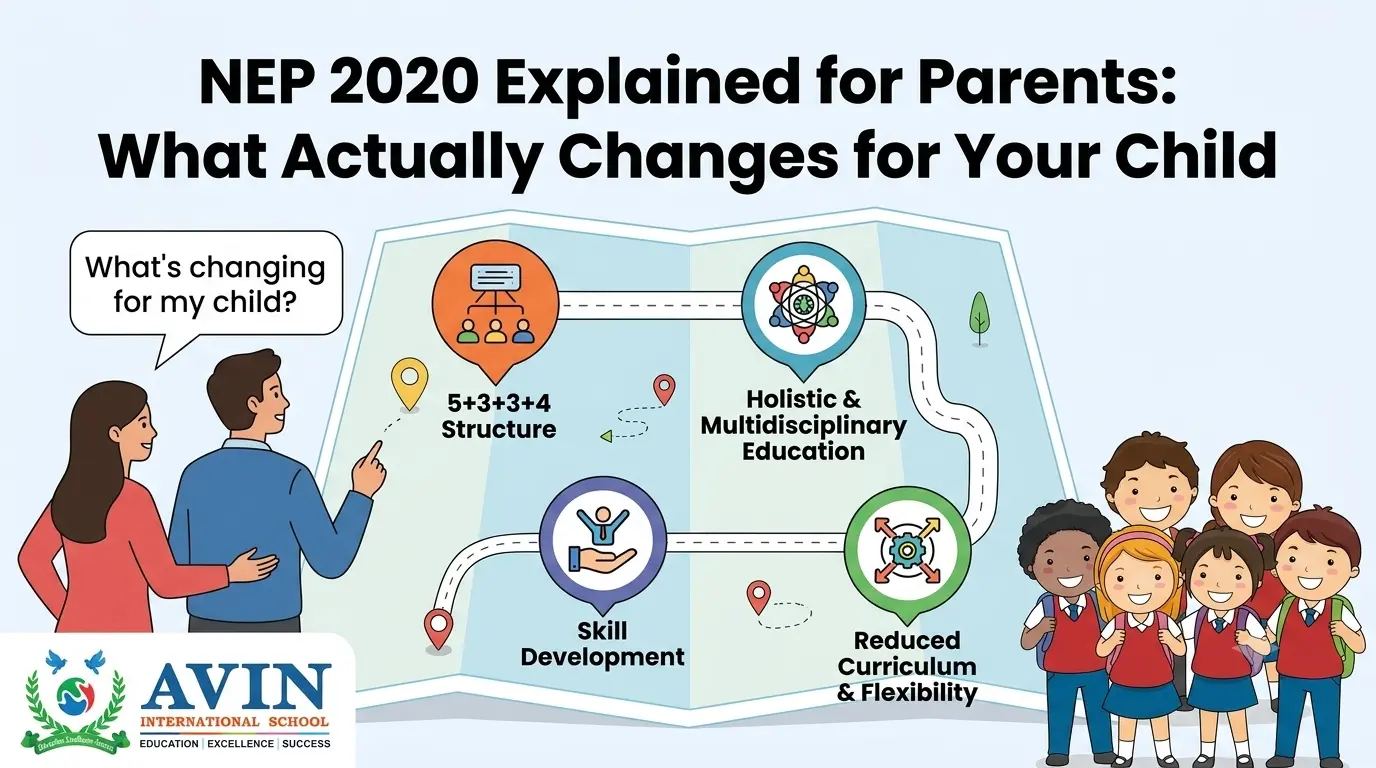
The most structural change NEP 2020 makes is to how schooling is organised. The old 10+2 framework ten years of school followed by two years of higher secondary has been replaced by a four-stage model that maps more closely onto how children actually develop cognitively and emotionally.
Here is what each stage looks like, and what it means in practice for your child.
| Foundational Stage Ages 3–8 | Pre-Primary through Grade 2 |
This stage formally integrates early childhood education into the school system for the first time something that did not exist in the old framework. The approach is explicitly play-based, activity-driven, and sensory-rich. Structured academic pressure at this stage is not just discouraged under NEP 2020; it is considered developmentally inappropriate.
What this looks like in practice: if your child is in Nursery, K1, K2, or Grade 1 or 2, and their school day involves more storytelling, building, drawing, singing, and exploration than worksheets and written exercises, that is not a sign of insufficient rigour. It is a sign that the school is implementing the policy correctly. The foundations built through play at this stage language, motor skills, social awareness, curiosity are the ones that support everything that comes after.
| Preparatory Stage Ages 8–11 | Grades 3 through 5 |
This stage bridges the play-based approach of the foundational years toward structured subject knowledge. Formal subjects are introduced mathematics, language, environmental studies but the emphasis remains on discovery, activity, and conceptual understanding over memorisation. Homework begins here, but it is designed to reinforce understanding rather than to reproduce content.
What this looks like in practice: parents of children in Grades 3 to 5 should expect more project-based work, group activities, and experiential tasks alongside traditional textbook content. A good NEP 2020-aligned Preparatory stage feels like a natural extension of curious learning, not a sudden shift into exam preparation.
| Middle Stage Ages 11–14 | Grades 6 through 8 |
This stage introduces deeper subject knowledge and abstract thinking, and it brings one of the most visible NEP 2020 changes: vocational exposure begins at Grade 6. Students receive structured engagement with practical skills coding, basic financial literacy, local crafts, agriculture, carpentry alongside their academic subjects. The aim is to ensure that by the time students face a career decision, they have already had real contact with the world of work rather than encountering it for the first time at seventeen.
What this looks like in practice: if your child in Grade 6, 7, or 8 comes home with a project that involves something that looks less like academics and more like a life skill, that is deliberate. It is one of the clearest and most practically significant departures from the old system.
| Secondary Stage Ages 14–18 | Grades 9 through 12 |
The most significant change at this stage is the gradual dismantling of the rigid arts, science, and commerce stream separation that has defined Indian secondary education for decades. Under NEP 2020, students will increasingly be able to combine subjects across traditional stream boundaries a student who loves physics but also wants to study music, or one who is drawn to biology but also to economics, should be able to do so without being forced to choose a single stream identity at fourteen.
What this looks like in practice: full subject flexibility is not yet universally implemented, and the transition is ongoing. But the direction is clear, and schools that are genuinely aligned with NEP 2020 are already broadening their subject menus. Encourage your child in Grades 9 and 10 to explore interests across disciplines rather than prematurely narrowing to what they think a particular stream demands.
Seven Changes That Affect Your Child’s Day-to-Day Learning
The stage structure is the skeleton of NEP 2020. What follows is the flesh the specific changes to how children are taught, assessed, and supported that parents notice in the classroom, the homework, and the report card.
Change 1: From rote learning to conceptual understanding
| Learning approach | Before NEP 2020 Memorize definitions, formulas, and answers. Reproduce them accurately in exams. | With NEP 2020 Understand concepts deeply. Apply them to new situations, questions, and real-world problems. |
This is the philosophical heart of NEP 2020, and it is the change that takes longest to fully embed because it requires teachers to teach differently, not just schools to adopt a new syllabus. Conceptual understanding means that a maths question might ask a student to explain why a formula works, not just which answer it produces. A science lesson might ask students to design an experiment rather than describe one from a textbook. A language exercise might require a student to argue a position rather than copy a paragraph.
What this means at home: if you are helping your child with homework and the question does not have a single correct answer, or if it asks for explanation and reasoning rather than a definition, that is not a poorly designed question. It is the policy in practice. Resist the instinct to look for the ‘right answer’ and instead ask your child: what do you think, and why?
Change 2: From annual high-stakes exams to continuous assessment
| Assessment model | Before NEP 2020 One or two major exams per year carry almost all the weight. A child’s grade reflects how they perform on a single day. | With NEP 2020 Regular assessments, projects, oral work, and classroom participation contribute throughout the year. Consistent effort is rewarded. |
Under the old system, a child who understood the material thoroughly but performed poorly on exam day due to anxiety, illness, or simply having a bad morning received a grade that did not reflect their actual learning. Continuous and Comprehensive Evaluation (CCE), which CBSE has been developing in line with NEP 2020, is designed to give a more accurate picture by distributing the assessment across the year.
What this means at home: your child’s grade is no longer determined entirely by how they perform in two sittings per year. Their participation in class discussions, their project submissions, their oral assessments, and their formative test performance all contribute. This places more value on consistent daily engagement and makes last-minute cramming a less effective strategy than it used to be.
Change 3: From rigid subject streams to flexible subject combinations
| Subject choice | Before NEP 2020 Fixed arts, science, or commerce streams from Grade 11. No mixing across streams. Choice made at 14, largely irreversible. | With NEP 2020 Students can combine subjects across traditional stream boundaries. A student can study physics alongside music, or commerce alongside biology. |
The arts-science-commerce trichotomy has long been one of the more limiting features of Indian secondary education. It asks a fifteen-year-old to choose an identity science student, arts student, commerce student and then structures an entire educational pathway around that single choice. NEP 2020 challenges this model directly, recognising that the most interesting and capable people rarely fit neatly into predetermined boxes.
What this means at home: if your child is approaching Grades 11 and 12, start a conversation about what they are genuinely curious about rather than which stream seems most prestigious or practical. The walls between subjects are being lowered slowly and unevenly, but genuinely. A school that has done this work will be able to show you what subject combinations are now available.
Change 4: From English-only instruction to mother tongue in early years
| Language of instruction | Before NEP 2020 English-medium instruction from early grades, even when it is not the child’s home language. | With NEP 2020 Mother tongue or regional language as the primary medium of instruction until at least Grade 5. English introduced progressively. |
This is one of the most research-backed and one of the most debated changes in NEP 2020. The evidence is consistent: children learn foundational concepts more effectively when instruction begins in the language they speak at home. Asking a three-year-old to learn what numbers mean, what shapes are called, and what stories sound like all simultaneously in a language that is not spoken at home is a significant cognitive burden that slows down rather than accelerates learning.
What this means at home: for families where Kannada, Tamil, Telugu, or another regional language is spoken at home, NEP 2020 explicitly supports early schooling in that language. This is not a step away from English proficiency it is a way of building the cognitive foundations that make English learning more effective when it comes. A child who is confident in their home language learns a second language faster and more thoroughly than one who is uncertain in both.
Change 5: From purely academic curriculum to vocational and life skills
| Curriculum scope | Before NEP 2020 Academic subjects only. Vocational and practical skills treated as separate, lower-status tracks. | With NEP 2020 Vocational exposure integrated from Grade 6 coding, financial literacy, local crafts, and more. Life skills embedded across the curriculum. |
One of the persistent criticisms of the old Indian education system was that students graduated with strong theoretical knowledge and almost no practical understanding of how the world works. They knew the formula for compound interest but had never applied it to a real financial decision. They could describe agricultural processes but had never touched soil. NEP 2020 addresses this directly by bringing practical, vocational, and life skills into the mainstream curriculum from Grade 6.
What this means at home: your child in Grade 6 or above may come home with projects that look less like traditional homework and more like real-world tasks building a basic budget, learning to code a simple programme, researching a local craft tradition, or exploring a community issue. These are not distractions from learning. They are the policy’s attempt to ensure your child’s education connects to the world they will actually live in.
Change 6: From marks-only report cards to holistic progress reports
| Progress reporting | Before NEP 2020 Grades in academic subjects. Minimal formal acknowledgment of character, creativity, or co-curricular growth. | With NEP 2020 360-degree holistic progress cards covering academic performance, social-emotional development, physical health, and co-curricular engagement. |
A report card that shows only subject grades is a report card that treats a child as a collection of academic scores. NEP 2020 calls for a fundamentally different document one that attempts to capture the full picture of who the child is becoming, not just what they know in each subject at the end of term.
What this means at home: if your child’s school is implementing this change, their progress report will look different from what most parents grew up with. Alongside subject grades, you will see comments on social-emotional development, physical health, creativity, and co-curricular participation. When you receive this report, resist the instinct to look only at the academic grades. The holistic comments are not padding they are the information that tells you who your child is at school.
Change 7: From teacher as lecturer to teacher as facilitator
| Teaching approach | Before NEP 2020 Teacher delivers content. Students listen, copy, and memorize. Questions are limited and often discouraged. | With NEP 2020 Teachers facilitate discussion, inquiry, and collaborative problem-solving. Students are expected to question, explore, and construct understanding. |
This is the change that most directly affects the texture of your child’s school day, and it is the one that requires the most from teachers. Facilitating genuine inquiry asking open questions, holding space for multiple answers, guiding students toward understanding rather than delivering it to them is a significantly different skill from traditional instruction. It requires training, practice, and a school culture that supports it.
What this means at home: if your child comes home saying ‘we spent the whole class discussing one question’ or ‘the teacher made us figure it out ourselves’, that is not a sign of insufficient teaching. It is a sign of effective teaching under the NEP 2020 model. A classroom where students argue about ideas, propose and test hypotheses, and build understanding through dialogue is a classroom doing precisely what the policy intends. The quiet, orderly class where a teacher speaks and students copy is no longer the gold standard.
What NEP 2020 Does Not Change
A few important clarifications, because the gap between policy promise and classroom reality is real, and parents deserve to know where it exists.
- Board exams are not going away. Grade 10 and Grade 12 board examinations continue. What changes is their relative weight continuous assessment, projects, and oral work now contribute alongside board results. The exam remains important; it is no longer the only thing that matters.
- CBSE affiliation does not change. A CBSE-affiliated school remains CBSE. The board’s curriculum and assessment frameworks evolve within NEP 2020 guidelines, but the affiliation itself is unaffected. If your child’s school is CBSE, it stays CBSE.
- Implementation is uneven. This is perhaps the most important thing to understand. NEP 2020 is a framework and a direction. A school that has invested in teacher training, curriculum redesign, and assessment reform will look and feel genuinely different from one that has updated its prospectus language but not its classrooms. The policy cannot guarantee quality only the school can do that.
- It is not yet fully complete. Some changes are already in classrooms. Others are still being phased in. The secondary stage subject flexibility, in particular, is at different points of implementation across different schools and states. Ask your child’s school specifically what has been implemented and what is still in progress.
| The policy represents a genuine and important shift in direction. The gap between intent and classroom reality is worth acknowledging honestly but the intent is worth taking seriously. A parent who knows the difference between the two is in a much stronger position to evaluate their child’s school. |
Five Questions to Ask Your Child’s School About NEP 2020
The best way to understand how much of NEP 2020 has actually reached your child’s classroom is to ask the school directly. Here are five specific questions that will tell you more than any brochure.
- How has the school structured the foundational stage? Is learning in Nursery through Grade 2 genuinely play-based, or is academic pressure starting earlier than the policy recommends? Ask to see a sample day’s timetable for the early years.
- What does continuous assessment look like in practice? What percentage of the grade is determined by projects, oral work, and classroom participation versus term-end exams? Ask for a breakdown by grade level.
- What vocational or life skills exposure does my child receive from Grade 6 onwards? What form does it take is it integrated into existing subjects or a standalone programme? How is it assessed?
- What does the holistic progress report include? Beyond academic grades, how is social-emotional development tracked and communicated to parents? Ask to see an example of the report format.
- How are teachers being trained for NEP 2020-aligned teaching? Facilitating inquiry-based learning is a significantly different skill from traditional instruction. Ask what ongoing professional development teachers are receiving to support this transition.
| At AVIN International School, Kengeri, NEP 2020 alignment is not a rebranding exercise. It is embedded in how we teach from Kindergarten through Grade 10 in our four-stage curriculum structure, in our continuous assessment model, in our vocational exposure at middle school, and in the facilitated, inquiry-based approach our teachers bring to every classroom. We can answer each of these questions specifically, and we welcome parents to come and see the answers in practice. |
What NEP 2020 Means, in the End
NEP 2020 is a genuine attempt to make Indian schooling fit for a world the 1986 policy could not have anticipated. It is trying to produce graduates who can think, not just recall. Who can apply knowledge, not just possess it. Who have encountered the world of work before they are asked to enter it permanently. Who are assessed as whole people, not as a set of exam scores.
Whether those intentions reach your child depends on the school. A policy becomes real in a classroom, with a teacher, with thirty children who each learn differently. The schools that have done the hard work of implementation the teacher training, the curriculum redesign, the assessment reform are the schools where NEP 2020 is not a term in a newsletter but a lived experience for children every day.
The questions in the previous section are the right place to start. A school that can answer them clearly, specifically, and with evidence is a school that has done the work.
If you would like to see what NEP 2020 implementation looks like in an actual classroom, we would welcome you at AVIN International School, Kengeri. Book a campus visit and see the difference between policy language and classroom practice for yourself.
Frequently Asked Questions
What is NEP 2020 and how does it affect my child’s school?
NEP 2020 is India’s National Education Policy, introduced in 2020, replacing a 34-year-old framework. It shifts schooling from rote memorisation and annual high-stakes exams toward conceptual understanding, continuous assessment, and holistic development. It applies to all schools in India, including CBSE-affiliated schools, and is being implemented gradually the impact on your child depends on how thoroughly their school has done the work of alignment.
Does NEP 2020 remove board exams?
No. Grade 10 and Grade 12 board examinations continue under NEP 2020. What changes is how much weight they carry relative to the rest of the year continuous assessment, projects, and oral work now contribute alongside board results. The goal is to reduce the exam’s role as the single decisive moment in a student’s academic life, not to eliminate examinations altogether.
What is the 5+3+3+4 structure in NEP 2020?
It replaces the old 10+2 school structure with four learning stages: the Foundational stage (ages 3–8, pre-primary through Grade 2), the Preparatory stage (ages 8–11, Grades 3–5), the Middle stage (ages 11–14, Grades 6–8), and the Secondary stage (ages 14–18, Grades 9–12). Each stage has a distinct pedagogical approach play-based in the foundational years, progressively more structured through to secondary.
Does NEP 2020 apply to CBSE schools?
Yes. CBSE has been updating its curriculum and assessment frameworks in alignment with NEP 2020 guidelines, and all CBSE-affiliated schools are expected to implement the policy. The degree of implementation varies significantly between schools. Some have invested deeply in teacher training and curriculum redesign; others are still in transition. Asking your child’s school specific questions about implementation is the most reliable way to understand where they stand.
What does NEP 2020 mean for homework and assessments?
Homework under NEP 2020 is designed to encourage thinking and application rather than repetition. Assessments include regular classwork, project submissions, oral evaluations, and formative tests alongside written term exams. The aim is to give a fuller, more accurate picture of what a child understands across the year not just what they can reproduce under time pressure on a single examination day.
How do I know if my child’s school is genuinely implementing NEP 2020?
Ask specific questions at your next parent-teacher meeting or school visit: What does continuous assessment look like in practice? What vocational exposure does my child receive from Grade 6? What does the holistic progress report include? How are teachers being trained for inquiry-based teaching? A school that has implemented NEP 2020 meaningfully will answer these questions concretely and with evidence. A school that responds with general statements about being ‘NEP-aligned’ without specifics is still catching up.