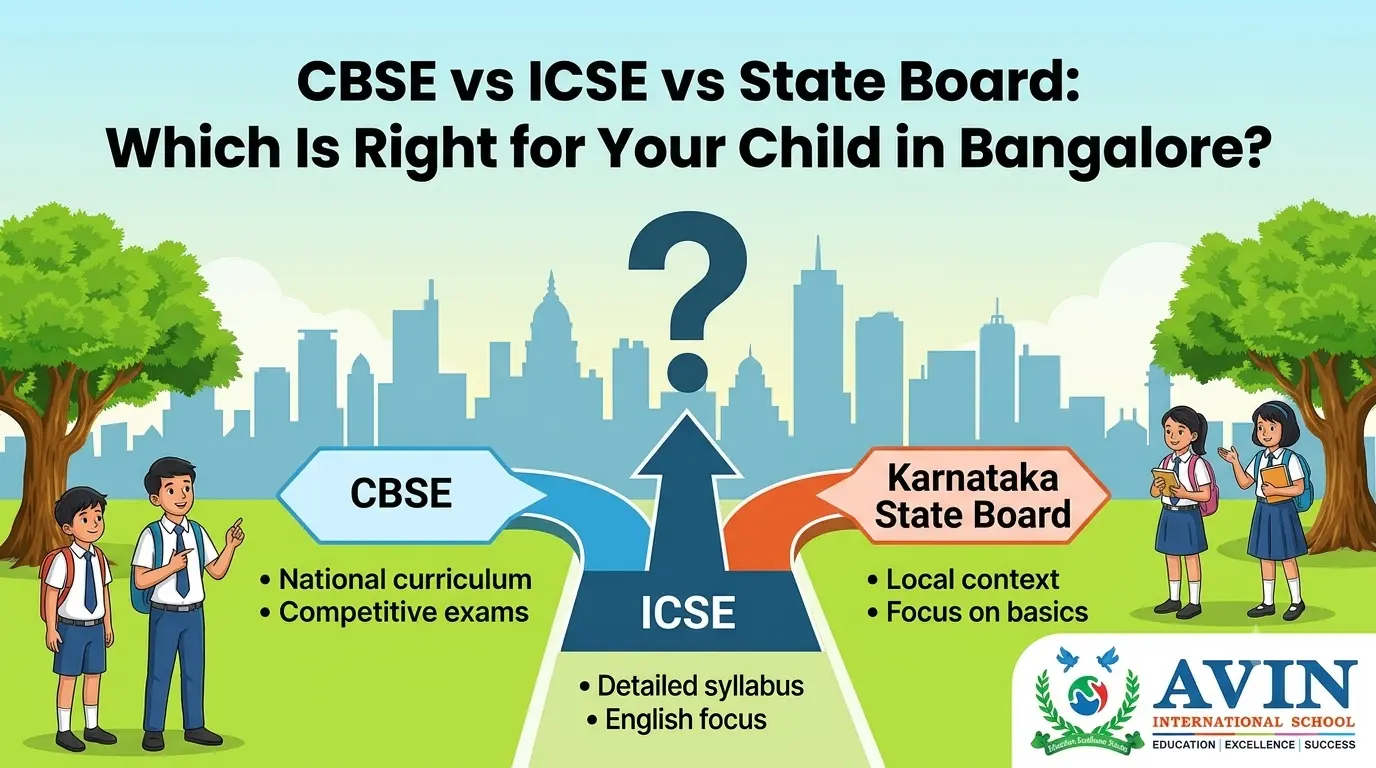
Ask ten Bangalore parents which school board they chose for their child, and you will likely get ten different answers — each delivered with complete conviction. Ask them to explain their reasoning, and the answers become considerably less consistent.
‘CBSE is best for competitive exams.’ ‘ICSE produces better-rounded students.’ ‘The State Board is underrated and perfectly fine.’ All three statements contain truth. None of them is the complete picture.
Bangalore is one of the few cities in India where all three major boards — CBSE, ICSE, and the Karnataka State Board — are well-represented and genuinely competitive. That makes the decision real. Unlike cities where one board dominates, parents here have a meaningful choice, which means the choice requires meaningful thought.
This guide does not declare a winner. What it does is break down each board honestly across six dimensions that actually matter to families: curriculum depth, language development, competitive exam alignment, assessment style, school transfer flexibility, and learner fit. By the end, you should have enough clarity to match a board to your child’s profile — rather than to the loudest opinion in your social circle.
If you are short on time, jump directly to the comparison table in the ‘At a Glance’ section.
A Quick Overview of Each Board
Before the comparison, a brief grounding in what each board actually is and who governs it.
CBSE — Central Board of Secondary Education
CBSE is a national-level board governed by the Government of India. Its curriculum is built around NCERT textbooks — the same textbooks that form the foundation of India’s most competitive national entrance examinations. It is the most widely available board in the country, with affiliated schools in every state and in several countries abroad. For families that may relocate, CBSE’s reach is unmatched. It has also been significantly modernised under NEP 2020, with a growing emphasis on conceptual understanding, activity-based learning, and reduced rote memorisation.
ICSE — Indian Certificate of Secondary Education

ICSE is governed by the Council for the Indian School Certificate Examinations (CISCE), a private board with a long-standing reputation for academic rigour. Its curriculum is broader than CBSE’s, covering more subjects in greater depth and placing particular emphasis on English language and literature. Internal assessments — projects, practicals, coursework — carry significant weight alongside final examinations. ICSE schools in Bangalore tend to be among the more established institutions, and the board is widely regarded as producing well-rounded, analytically strong students. It has fewer affiliated schools than CBSE, but its presence in Bangalore is solid.
Karnataka State Board — KSEEB
The Karnataka Secondary Education Examination Board governs the State Board curriculum. It is taught primarily in Kannada medium, with English medium options available at most schools. The State Board is the most affordable of the three — school fees tend to be significantly lower, and the academic pace is generally more gradual. For families settled in Karnataka with children likely to pursue professional courses through the Karnataka Common Entrance Test (CET), the State Board’s syllabus alignment is a genuine advantage. It is also the board that grounds children most deeply in Karnataka’s language, history, and culture.
The Six Dimensions That Actually Matter
Rather than a generic list of pros and cons, what follows is a comparison across six specific dimensions that parents consistently raise when choosing a board. Each dimension ends with a short synthesis so you can see the pattern clearly.
1. Curriculum style and depth
How is the content structured, and how much weight does each board place on understanding versus memorisation?
- CBSE builds its curriculum around NCERT textbooks that are carefully designed, well-tested, and revised regularly. The focus is on conceptual clarity — understanding why a formula works, not just how to apply it. The curriculum is structured and systematic, which suits a wide range of learners.
- ICSE is broader and considerably more detailed. It covers more subjects across arts, sciences, and languages, with each subject treated in greater depth. This produces well-rounded students but also generates a higher workload. Students are expected to read widely, write extensively, and engage analytically with content rather than simply reproduce it.
- State Board is grounded in local context. Content is tied to Karnataka’s geography, history, and culture, which makes learning feel relevant and accessible for many students. The pace is more measured, which can be an advantage for students who need time to consolidate concepts before moving forward.
| Synthesis: CBSE is the most efficient path to competitive exam readiness. ICSE produces the broadest academic exposure. The State Board offers the strongest local grounding and the most accessible pace. |
2. Language and communication skills
How does each board develop English proficiency, and what kind of communicator does each produce?
- CBSE treats English as a core subject from early grades, but it is one component within a larger curriculum. The depth of language teaching varies considerably between schools — a CBSE school that prioritises English communication can produce excellent results, while one that does not may leave students competent but not particularly expressive.
- ICSE is widely considered the strongest board for English language and literature development in India. From the early grades, students write essays, analyse texts, and participate in oral assessments. The board’s internal assessment structure means that communication skills are practised and evaluated consistently, not just tested once a year. Students who go through ICSE typically graduate as confident, articulate writers and speakers.
- State Board prepares students effectively in Kannada, which is both a strength and a limitation depending on the child’s context. English medium options have improved significantly, but English language development is generally not the State Board’s primary focus. Students planning careers in English-medium professional environments may find they need additional language support.
| Synthesis: If strong English communication is a priority, ICSE has a structural advantage built into its curriculum design. CBSE is competitive but depends more on the individual school’s commitment to language teaching. |
3. Competitive exam alignment
Which board best prepares students for JEE, NEET, UPSC, and other national entrance examinations?
- CBSE has a clear, structural advantage here. JEE (for engineering), NEET (for medicine), and most national scholarship examinations are based directly on the NCERT syllabus that CBSE follows. Students preparing for these exams from a CBSE background are working from the same textbooks, which significantly reduces the additional coaching burden.
- ICSE students absolutely crack JEE and NEET — the board’s emphasis on analytical thinking and problem-solving is a genuine asset. However, they typically require additional coaching to bridge the NCERT gap, since ICSE’s curriculum, while broader, does not map directly onto the exam syllabus. The transition requires deliberate effort, particularly from Grade 9 onwards.
- State Board is well-aligned with the Karnataka Common Entrance Test (CET), which governs admissions to engineering and medicine colleges within Karnataka. For students planning to study and work in Karnataka, this alignment is a genuine advantage. For national competitive exams, however, a similar NCERT gap exists as with ICSE.
| Synthesis: For families with a clear JEE or NEET target, CBSE is the most direct route. For Karnataka CET, the State Board is naturally aligned. ICSE serves competitive exam aspirants well but requires bridging. |
4. Assessment and grading
How are students evaluated — purely through annual examinations, or through a mix of continuous assessment and project work?
- CBSE uses a Continuous and Comprehensive Evaluation (CCE) model that combines regular assessments, project work, oral evaluations, and term-end exams. The grading system — A1 through E — was designed to reduce the high-stakes anxiety of a single annual exam. The approach rewards consistent effort and everyday learning, not just exam performance.
- ICSE carries the highest internal assessment weightage of the three boards. Coursework, practicals, projects, and oral assessments contribute significantly to the final grade throughout the year. This benefits students who perform better through sustained effort and independent work than through a single high-pressure examination. It also means that final exam pressure, while real, is not the only determining factor.
- State Board has traditionally placed the heaviest emphasis on final board examinations, with end-of-year exams carrying the largest share of the total grade. This is gradually evolving with curriculum reforms, but the exam-centric model remains more prominent than in the other two boards.
| Synthesis: Both CBSE and ICSE offer more holistic assessment models than the State Board. ICSE’s internal assessment weightage is the highest of the three, which suits students who thrive on consistent coursework rather than exam-day performance. |
5. Portability and school transfer
How straightforward is it to transfer a child between schools — whether within Bangalore, across states, or internationally?
- CBSE is the most portable board in India. With thousands of affiliated schools across every state, CBSE transfers are seamless — the curriculum, the textbooks, and the academic calendar are standardised nationally. It is also the dominant board in Indian schools abroad, particularly in the Middle East, Southeast Asia, and East Africa. For families in transferable professions — corporate, defence, civil services — CBSE is the obvious and safest choice.
- ICSE is nationally recognised and well-regarded, but the number of affiliated schools is significantly smaller than CBSE. In major cities, transfers are manageable. In smaller cities or towns, finding a comparable ICSE school can be difficult, which can force a mid-education board change — a disruptive experience for any child.
- State Board is the least portable of the three. It is primarily relevant within Karnataka, and a child transferring to another state would face a significant curriculum adjustment. For families confident they will remain in Karnataka, this is not a concern. For those with any possibility of relocation, it is worth factoring in seriously.
| Synthesis: Portability is CBSE’s clearest structural advantage. If there is any chance the family may relocate in the next ten years, CBSE eliminates the risk of a mid-education curriculum disruption. |
6. Workload and learner fit
Which board suits which type of learner, and what does the day-to-day academic pressure look like?
- CBSE is well-paced for the majority of learners. The standardised curriculum means the workload is predictable and manageable when supported by a school with strong teaching. It works well for average, above-average, and high-performing students alike. It does not overwhelm students who need a steady pace, and it does not under-challenge those who learn quickly.
- ICSE carries a significantly higher workload, particularly from middle school onwards. The breadth of subjects, the volume of reading and writing, and the continuous assessment demands make it best suited to students who are academically curious, self-motivated, and genuinely enjoy learning for its own sake. For students who find academic pressure difficult to manage, the ICSE workload can become a source of sustained stress.
- State Board generally has the most gradual pace and the lowest academic pressure of the three. This is not a weakness — for students who need more time to consolidate learning, or for families where the child’s overall well-being is the primary concern, a less pressured academic environment has real value.
| Synthesis: Match the board to the child — not to social expectations or what a neighbour chose. An average learner who thrives in a supportive CBSE school will consistently outperform a struggling student in a prestigious ICSE institution. |
At a Glance: CBSE vs ICSE vs State Board
The table below summarises the six dimensions. Use it as a quick reference, not as a final verdict.
| Dimension | CBSE | ICSE | State Board (Karnataka) |
| Curriculum style | Conceptual, NCERT-based | Broad, detail-rich | Local, context-grounded |
| English strength | Good | Excellent | Moderate |
| Competitive exam fit | Excellent (JEE / NEET) | Good (extra coaching needed) | Strong for Karnataka CET |
| Assessment model | Continuous + exams (CCE) | High internal weightage | Primarily exam-based |
| Portability | Highest in India | Good nationally | Primarily Karnataka |
| Academic workload | Moderate, well-paced | High | Lower pace |
| Best suited for | Most learner profiles | Curious, writing-strong learners | Local career paths |
| Affordability | Wide range of schools | Generally higher fees | Most affordable |
Which Board Is Right for Your Child? A Decision Framework
The table above shows you what each board offers. This section helps you match those offerings to your specific situation. Rather than a general recommendation, here are four parent profiles that reflect the most common decision contexts for Bangalore families.
| Profile 1 — ‘We are in a transferable profession and may relocate in the next few years’ Recommendation: CBSEThis is the clearest case. CBSE’s national reach — and its significant presence in international cities with large Indian communities — means your child can transfer between schools with minimal disruption. The textbooks are the same, the calendar is similar, and the curriculum will be familiar wherever you land. Choosing any other board introduces real risk if a move becomes necessary mid-education. |
| Profile 2 — ‘My child is an avid reader, loves writing, and engages well with debate and discussion’ Recommendation: ICSEThis learner profile is ICSE’s sweet spot. The board’s deep investment in English language and literature, its internal assessment structure, and its broad subject coverage reward students who are naturally curious, enjoy expressing themselves, and thrive when learning involves reading widely and thinking independently. If your child finds formal examinations stressful but performs well through consistent effort, ICSE’s continuous assessment model is also worth considering. |
| Profile 3 — ‘We are planning for IIT-JEE, NEET, or national scholarship examinations’ Recommendation: CBSEThe NCERT syllabus that CBSE follows is the foundation of JEE and NEET preparation. CBSE students are working from the same textbooks as the exam setters, which is a meaningful advantage in the senior school years. This does not mean ICSE students cannot crack these exams — many do — but they typically require additional coaching to close the syllabus gap. For families with a clear national competitive exam target, CBSE removes a layer of unnecessary complexity. |
| Profile 4 — ‘We are settled in Bangalore and my child will likely pursue professional courses in Karnataka’ Recommendation: State Board or CBSEThe Karnataka State Board is a legitimate and underrated option for families in this situation. Its curriculum is well-aligned with the Karnataka CET, and the lower fee structure makes it genuinely accessible. For students targeting medicine or engineering colleges within Karnataka, the syllabus match is a real advantage. CBSE is also a strong choice here, particularly if the school’s quality and campus environment are superior. The deciding factor in this profile is often school quality rather than board. |
The Board Is a Framework. The School Is What Matters.
There is one more thing worth saying clearly, because it often gets lost in the board debate.
The same board can produce dramatically different outcomes depending on the school that delivers it. A well-run CBSE school with trained teachers, a strong reading culture, active co-curricular programmes, and genuine parent communication will outperform a poorly run ICSE school at almost every measurable outcome — academic results, student confidence, communication skills, and emotional well-being.
The board sets the framework. The school determines the quality of what happens within that framework.
When visiting schools, regardless of which board they follow, look for these things:
- Teacher quality and training: Are teachers well-qualified and regularly trained? How do they handle a child who is struggling versus a child who is ahead?
- How assessments are conducted: Not just results — how is progress communicated to parents? Are there regular interactions, not just report cards?
- Co-curricular depth: Are arts, sports, and activities genuinely integrated, or are they peripheral?
- Safety and campus environment: Does the campus feel secure, well-maintained, and child-friendly?
- The school’s communication style: Do they welcome questions and stay accessible? A school that communicates openly with parents is a school that has nothing to hide.
Visit the campus. Sit in on a class if the school allows it. Talk to current parents — not on the school’s curated parent panel, but parents you meet independently. The impression you get in person will tell you more than any ranking.
| At AVIN International School, Kengeri, we follow the CBSE curriculum because we believe in its balance of conceptual rigour, national competitive exam readiness, and the flexibility that NEP 2020 brings. But we hold firmly to the belief that the board is a framework — it is what happens within that framework that defines the quality of your child’s education. We welcome all parents to visit our campus, sit with our teachers, and see what that looks like in practice. Know – What Makes AVIN International School Different from Other CBSE Schools |
Choosing with Confidence
There is no universally correct answer to the question of which board is best. There is only the answer that is best for your child, your family’s circumstances, and your long-term goals.
CBSE is the right choice for most families — it is versatile, nationally portable, aligned with competitive exams, and available at a wide range of schools across Bangalore. But ICSE is the right choice for the right child, and the State Board is a perfectly legitimate path for families settled in Karnataka with local career goals.
What matters more than the board you choose is the school you choose within that board. A great school with strong teachers, a safe campus, and a genuine commitment to every child’s growth will serve your child far better than the prestige of a board name alone.
If you are exploring CBSE schools in Kengeri, Bangalore, we would love to show you what learning looks like at AVIN International School. Book a campus visit or speak to our admissions team at avininternationalschool.com. Admissions are open for 2026–27 from Nursery to Grade 10.
Frequently Asked Questions
Which is better, CBSE or ICSE?
Neither board is universally better — it depends on your child’s learning style and your family’s goals. CBSE is better suited for competitive exam preparation and school transfers. ICSE is better suited for students who are strong in English, enjoy broad academic exposure, and thrive through continuous assessment rather than single-exam performance.
Is CBSE harder than the Karnataka State Board?
CBSE is generally considered more rigorous, particularly in science and mathematics, and moves at a faster pace. The State Board is more accessible in terms of workload and pace, and is well-aligned with Karnataka-specific career paths such as the CET. Neither is ‘hard’ or ‘easy’ in absolute terms — the difficulty experienced depends heavily on the school and the child.
Which board is best for IIT-JEE preparation?
CBSE, clearly. JEE is based on the NCERT syllabus, which is the foundation of CBSE’s curriculum. Students from a CBSE background have a direct syllabus alignment advantage and typically require less bridging coaching compared to students from ICSE or State Board backgrounds.
Can I change my child’s board mid-school?
Yes, but it requires planning. The smoothest transitions happen at natural grade boundaries — entering Grade 1, Grade 6, or Grade 9. Switching from State Board to CBSE involves a curriculum adjustment that is manageable with the right school support. Mid-year board changes are possible but more disruptive, particularly in the secondary grades.
Which board is most recognised internationally?
CBSE is widely recognised in countries with significant Indian diaspora populations, including the UAE, Singapore, Malaysia, and several African nations. ICSE also carries international recognition. For full international curriculum equivalence — for university admissions in the UK, US, or Europe — the IB or Cambridge (IGCSE) boards are more directly relevant.
Which are the best CBSE schools in Kengeri, Bangalore?
AVIN International School, Kengeri is consistently regarded as one of the leading CBSE schools in the area, known for its modern infrastructure, personalised learning approach, strong co-curricular programme, and safe campus environment. For a full list of top CBSE schools in Kengeri, refer to our detailed guide at avininternationalschool.com.